
Blog
The Infrastructure Behind Access: DTCC, NSCC, and the Operational Layer of Distribution
Diana Manduca | 19 October 2026
How standardized transaction processing and accurate product data complete the distribution operating model.
This is Part 3 of a three-part series on how dealer services and market infrastructure turn strategy into access. Read Part 1 and Part 2.
Dealer agreements establish relationships, but relationships alone do not create scalable processing. A fund must also be represented accurately in industry systems, connected to the appropriate transaction and settlement infrastructure, and supported through launches, conversions, and ongoing change. This is where Depository Trust & Clearing Corporation (DTCC) and its National Securities Clearing Corporation (NSCC) subsidiary become an essential part of the distribution story.
PINE Advisor Solutions’ Distribution Services brings DTCC/NSCC support into the same distribution services framework as Dealer Services. That integration matters because intermediary onboarding often depends on the fund’s operational capabilities, while operational setup depends on accurate information from the fund sponsor, transfer agent, and other service providers.
The Rails Beneath Fund Distribution
Fund/SERV, provided through DTCC, is an industry-standard utility for processing and settling transactions in mutual funds and other pooled investment products between fund companies and distributors. Standardized processing reduces the manual handoffs, inconsistent formats, and reconciliation challenges that would otherwise grow with transaction volume. Related networking capabilities support the exchange of account and position information between funds and intermediaries.
For a fund sponsor, participation is not merely a back-office consideration. Many intermediaries expect compatible transaction processing, settlement, and data capabilities as part of onboarding. The ability to support those expectations can directly influence how efficiently a product moves from approval to availability.
Sponsorship Creates the Operating Connection
PINE maintains NSCC membership and can sponsor client NSCC numbers under its parent relationship. For a new sponsorship, PINE coordinates the activation process with DTCC, the fund sponsor, and the transfer agent; gathers the necessary legal-entity, fund-family, and operating information; manages required forms; and confirms that the setup is reflected correctly before downstream work proceeds.
When a fund changes distributors, the existing NSCC number can generally move from the prior distributor’s relationship to PINE’s. That continuity can help preserve established data and transaction flows, but the conversion still requires careful project management. Notice periods, blackout dates, relinquishment requirements, transfer-agent readiness, service-provider changes, and post-conversion monitoring must all be coordinated.
The conversion standard. A successful conversion is not defined only by the moment an account changes affiliation. It is defined by the continuity of processing before, during, and after the transition.
Offshore or Undertakings for Collective Investment in Transferable Securities (UCITS) structures can be supported and will also require direct involvement from a settlement bank. UCITS are Europe-domiciled fund structures organized under E.U. regulatory standards. Many UCITS sponsors, along with other offshore fund issuers, want their products available to investors beyond their home market, including through a U.S. broker-dealer distribution channel. Reaching investors that way generally requires the same NSCC-compatible transaction processing and settlement capabilities that domestic funds rely on, capabilities offshore sponsors and their non-U.S. service providers do not typically maintain on their own. PINE can extend NSCC sponsorship to these structures under its own membership, giving offshore and UCITS sponsors access to that infrastructure without each fund needing its own NSCC membership. Because offshore settlement conventions differ from the U.S. domestic market, this sponsorship also depends on the direct participation of a settlement bank, along with close coordination among PINE, the transfer agent and the settlement bank to confirm that account and cash-movement details are properly aligned before the fund begins trading through U.S. channels.
Product Data Aids Distribution Infrastructure
Intermediaries need more than a fund name and ticker. They rely on structured information about share classes, CUSIPs, fees, commissions, contingent deferred sales charges, breakpoints, blue-sky eligibility, and other operating rules. Mutual Fund Profile Service II (MFPS II) provides centralized security issue identification and distribution databases through which this information can be maintained and made available to intermediary partners.
PINE can provide MFPS II set up and maintenance as an additional service. The work begins with the correct share-class and CUSIP structure and can include Security Issue ID setup, profile data, dividend and capital-gain information, fee schedules, and ongoing updates following prospectus changes or supplements. When a new CUSIP is required, CUSIP ordering and the corresponding Fund/SERV security-level setup must be sequenced and supported with transfer-agent operating details.
This work illustrates an important point: product data is not administrative residue. It is part of the product’s distribution identity. Incomplete or inconsistent data can delay onboarding and create processing issues. Accurate, timely maintenance supports both access and investor servicing.
Operations Continue After Go-Live Date
Once sponsorship, conversion, or security setup is complete, PINE monitors the DTCC environment for pending items, profile updates, and settlement delays. Issues may require coordination with the transfer agent, settlement bank, intermediary, or DTCC relationship team. Material items are tracked through resolution, and records of forms, approvals, activation confirmations, and key communications are retained.
One Distribution Operating Model
The three parts of this series describe one connected system. Dealer Services helps identify and develop intermediary relationships. Due diligence and agreements define the legal and commercial framework. Payment administration and reconciliations support ongoing control. DTCC/NSCC services provide the standardized processing, settlement, and data infrastructure that allows those relationships to function at scale.
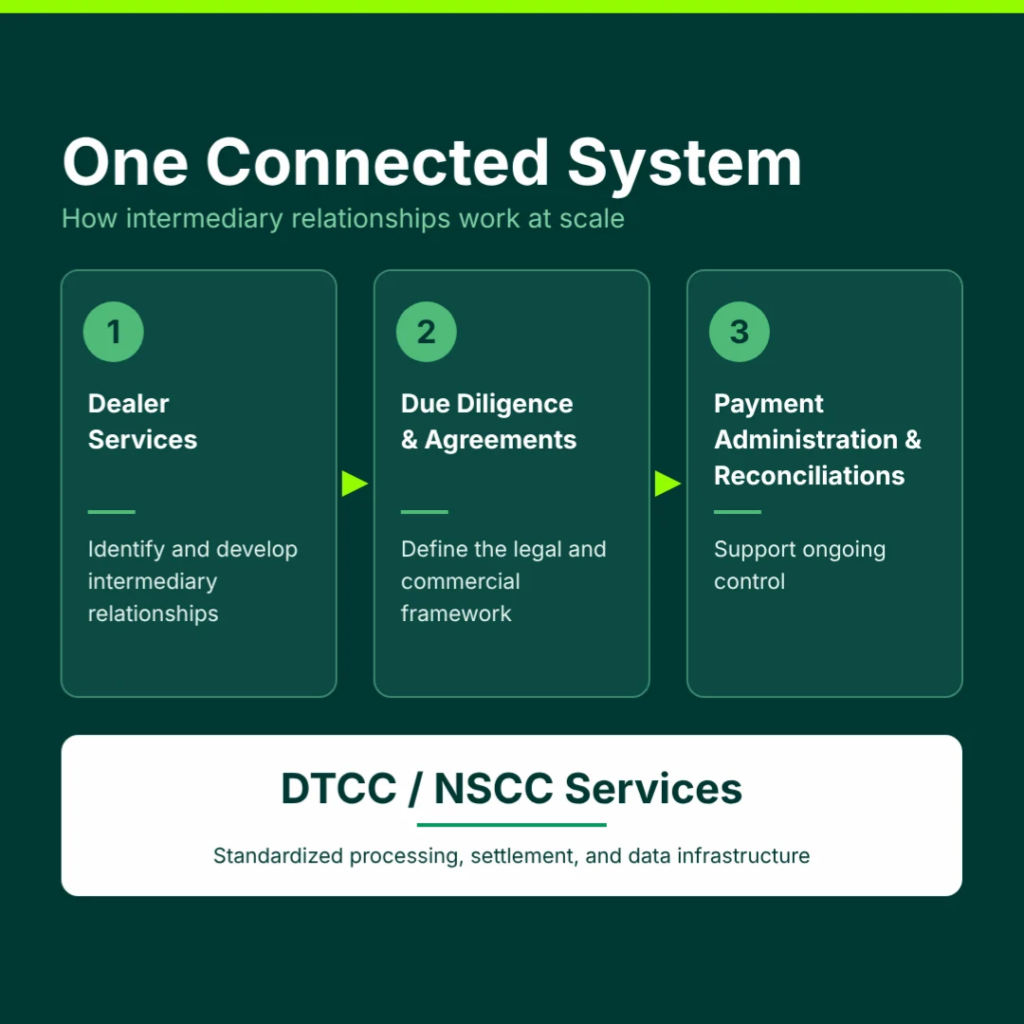
For fund sponsors, the benefit is a more coordinated approach to launch, growth, and change. Rather than solving platform, agreement, and operational questions in isolation, PINE brings them into a common distribution workflow — one designed to improve readiness, reduce avoidable friction, and maintain continuity over the life of the product.
Series conclusion: Distribution is strongest when market relationships and market infrastructure are designed to work together. To learn more, reach out to us anytime.