
Blog
What SEC Examinations Really Look Like From the Inside
Kenny Bossert | 3 August 2026
An Insider's Perspective on How the SEC Examination Program Works
Investment advisers spend precious time worrying about and preparing for the possibility of an SEC examination, yet relatively few understand how the examination process actually works behind the scenes.
Common questions often arise before an examination begins:
- Why was our firm selected?
- Does receiving an exam mean the SEC believes something is wrong?
- What happens after the initial request letter arrives?
- How are findings determined?
- What differentiates firms that navigate examinations smoothly from those that struggle?
The reality is that SEC examinations are often far less mysterious than they seem. The process follows a structured framework designed to assess compliance with federal securities laws, evaluate risks, and protect investors. Understanding that framework can help firms prepare more effectively, respond more efficiently, and reduce unnecessary disruption when an examination occurs.
The Purpose of SEC Examinations
The SEC's Division of Examinations serves several important functions within the regulatory ecosystem.
At its core, the examination program seeks to determine whether regulated entities are operating in accordance with federal securities laws and regulations, whether disclosures are consistent with representations made to clients and investors, and whether firms maintain compliance policies and procedures that are reasonably designed to meet regulatory requirements.
The examination program mission stands on four pillars:
- Improve industry compliance
- Prevent fraud
- Monitor risks
- Inform regulatory policy decisions
Importantly, examinations are not solely about identifying violations. They are also a mechanism for understanding industry practices, assessing emerging trends, and encouraging stronger compliance programs.
This distinction matters because many firms approach examinations as adversarial events. In reality, the process is generally focused on fact-finding, risk assessment, and evaluating whether firms are operating as represented. Examiners are not given a direction to “find deficiencies” or “disrupt the firm’s business” but rather develop and follow specific procedures to test for compliance with the applicable rules and laws to the scope areas being reviewed.
How the Division of Examinations is Organized
The SEC's Division of Examinations operates through a combination of headquarters-based programs and regional offices.
While headquarters establishes standards, priorities, strategy, and specialized expertise, much of the actual examination work is conducted through ten regional offices located throughout the United States. These regional offices include locations such as Denver, New York, Chicago, Boston, Los Angeles, San Francisco, Atlanta, Miami, Philadelphia, and Fort Worth.
The Division is organized around several core examination programs, including:
- Investment Adviser and Investment Company examinations
- Broker-dealer examinations
- FINRA and securities industry oversight
- Clearance and settlement examinations
- Technology controls examinations
- Event and emerging risk reviews
This structure allows the SEC to deploy both industry expertise and specialized subject matter knowledge when evaluating firms.
For registrants, this means examination teams may include individuals with expertise in specific products, trading strategies, operational functions, cybersecurity controls, or regulatory requirements relevant to the firm's business model.
Within each group, there are also specialty groups, such as the Private Fund Unit in the Investment Adviser and Investment Company group.
How Firms Are Selected for Examination
One of the most common misconceptions about SEC examinations is that being selected automatically indicates that the SEC suspects misconduct. In most cases, that assumption is incorrect.
The Division of Examinations operates a risk-based examination program where firms are selected based on a wide range of factors, many of which have little to do with suspected wrongdoing.
Division staff utilize many resources when determining examination candidates, including the following:
- Regulatory filings
- Publicly available information
- Firm and product risk profiles
- Data analytics and surveillance indicators
- Tips, complaints, and referrals
- Statutory mandates
- Thematic compliance risk reviews
These inputs are analyzed through a combination of centralized risk assessment functions and regional examination leadership. Examination plans are then developed based on available resources, identified risks, and national priorities.
One important point often surprises registrants: as a Division policy, the specific reason a firm was selected for examination is not disclosed.
Different Types of SEC Examinations
Not all examinations are created equally. The scope, intensity, and focus of an examination often depend on why it was initiated.
Common examination categories include:
Periodic Risk-Based Examinations
These are among the most common examination types. Firms are selected as part of the SEC's ongoing risk-monitoring activities.
Event-Driven Examinations
Certain events may trigger examination activity, including complaints, referrals, market events, or specific concerns that warrant additional review.
Thematic Reviews
The SEC periodically conducts examinations focused on particular risk areas or industry themes. These initiatives may span multiple firms and seek to assess industry-wide practices.
New Registrant Examinations
Newly registered firms often receive examinations relatively early in their regulatory lifecycle for the purpose of learning about the firm and informing the firm about the examination program.
Corrective Action Reviews
Firms that have previously identified deficiencies may be revisited to evaluate remediation and correction efforts.
Statutory or Programmatic Examinations
Certain examinations occur because they are required or prioritized under specific regulatory mandates.
The examination format can also vary significantly. Examinations may be announced, unannounced, remote, on-site, narrowly focused, or broad in scope. The structure is typically determined by risk factors, examination objectives, and available resources.
What Happens Before an Examination Begins
Long before a request letter arrives, examination teams engage in exam planning. Resources are allocated, potential overlaps with other regulators are considered, and an initial scope is developed.
That scope may be informed by:
- Prior examinations
- Regulatory filings
- Market developments
- Emerging risks
- Product complexity
- Business model considerations
Only after this planning process is complete does the examination formally launch. This preparation explains why examination teams often arrive with detailed questions and targeted requests.
The Examination Lifecycle
While every examination differs, most follow a relatively consistent sequence.
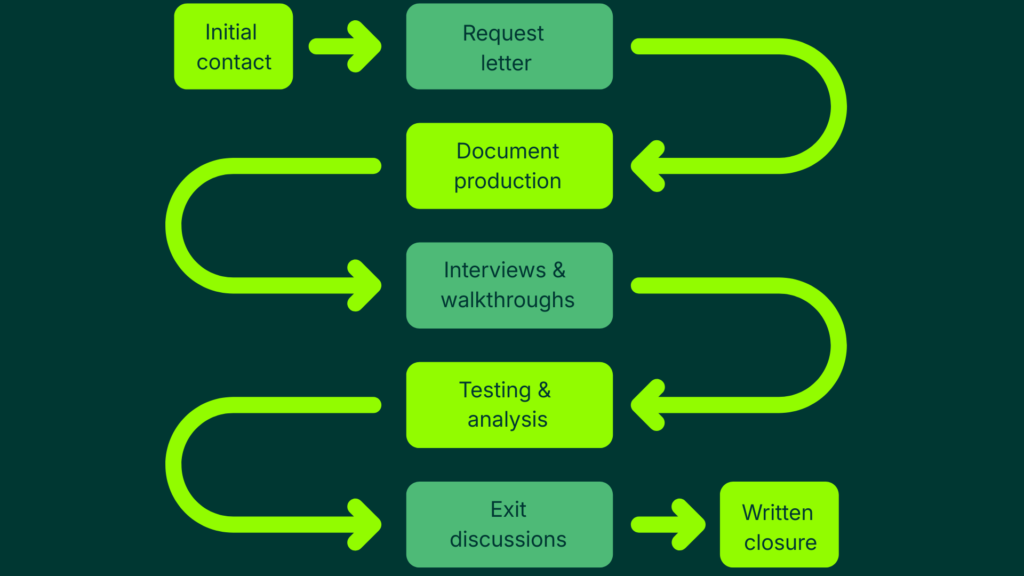
1. Initial Contact
For announced examinations, the process typically begins with a phone call to the firm's Chief Compliance Officer or designated regulatory contact.
2. Request Letter
The firm receives an initial document and information request. This request often serves as the foundation for the examination and can cover a wide range of operational, compliance, governance, and client-related materials.
3. Document Production
Requested records are generally provided electronically through secure transmission channels.
Most firms quickly discover that the initial request letter is only the beginning. Supplemental requests are common and should be expected as examiners identify areas requiring additional review.
4. Interviews and Walkthroughs
Examination teams frequently conduct interviews with compliance personnel, operational staff, management teams, and other relevant stakeholders.
These discussions help examiners understand how policies function in practice and whether actual operations align with documented procedures. Office tours may also occur during on-site examinations.
5. Testing and Analysis
This phase typically involves detailed reviews of:
- Client accounts
- Trading activity
- Portfolio management practices
- Marketing materials
- Compliance records
- Operational controls
Sampling methodologies, data analytics, and transaction testing may all be utilized depending on examination objectives.
6. Exit Discussions
Examinations conclude with an exit conference where preliminary observations are discussed, and firms have an opportunity to correct misunderstandings, provide context, or explain remediation efforts already underway.
7. Written Closure
The final stage involves formal written communication in the form of a letter, regarding examination outcomes.
Why Some Examinations Feel More Difficult Than Others
Many firms assume examination difficulty is driven primarily by regulatory scrutiny.
In practice, operational readiness often plays a much larger role.
When records are difficult to locate, policies are disconnected from actual practices, responsibilities are unclear, or data must be gathered manually from multiple sources, even routine requests can become time-consuming and stressful.
Conversely, firms with mature operational infrastructure often experience significantly smoother examinations because they can quickly produce information, explain processes, and demonstrate controls.
The examination itself may not be fundamentally different. The difference is often the firm's ability to respond efficiently.
This is one reason operational maturity has become increasingly important. Strong compliance programs depend not only on policies, but also on the operational systems, workflows, and documentation that support those policies.
What Makes for a Smoother Examination
Several characteristics consistently help examinations proceed more smoothly.
A Clear Point of Contact
Examiners benefit when firms designate a central coordinator who manages requests, communications, and document production. Without clear ownership, requests can become fragmented and response times may suffer.
Evidence That Matches Policies
One of the most important principles is straightforward: Can the firm demonstrate that it actually does what its policies say it does? Well-documented controls, records, and testing results help create that connection.
Organized and Timely Productions
Fast, complete responses reduce unnecessary follow-up requests and help maintain examination momentum. When information gaps exist, prompt explanations are often more effective than silence.
Tip: Firms should ensure that they can create a complete and accurate trade blotter prior to the examination. Trouble producing this single required record can extend the time and effort needed to complete the examination.
Proactive Communication
If a firm has identified an issue and already begun remediation, communicating that fact early can provide valuable context and often lessens any future SEC action.
No Surprises
Firms generally benefit from discussing known concerns openly rather than hoping issues remain undiscovered. Examiners appreciate this open approach and helps them feel more comfortable that the firm is not hiding issues it is aware of.
Understanding Examination Outcomes
At the conclusion of an examination, firms typically receive one of several outcomes.
No Further Action Letter
A no further action letter indicates that the examination has concluded without identified findings requiring formal action.
However, firms should avoid interpreting this outcome too broadly. It does not necessarily mean every activity was reviewed, nor does it guarantee that every aspect of the firm's operations was deemed perfect.
Deficiency Letter
The most common examination outcome is a deficiency letter. Deficiency letters identify concerns or observations and generally require a written response describing planned or completed remediation efforts.
Responses are often expected within approximately 30 days, with staff potentially providing additional feedback afterward.
Referral or Escalation
Certain issues may be referred to:
- SEC Enforcement
- Self-regulatory organizations
- State or other Federal regulators
- Criminal authorities
It's important to know that referrals can occur without a deficiency letter or exit conference.
What Happens After the Exam Ends
The end of an examination is often the beginning of the remediation process. This involves more than simply drafting a response. Effective remediation requires identifying root causes, implementing corrective actions, assigning ownership, documenting progress, and maintaining evidence that changes have been completed and tested. In many cases, the remediation process can strengthen controls and improve operational efficiency well beyond the specific issue identified during the examination.
It's also important to understand that a closed examination does not necessarily mean the SEC agrees with a firm's response or that future regulatory action is impossible. Examination outcomes do not prevent additional action if concerns remain.
If questions or concerns arise during the examination process, firms are encouraged to discuss them with examination staff and their supervisors. The SEC also maintains an Examination Hotline for comments, concerns, or requests to speak with Division of Examinations counsel or the Office of Inspector General.
Ultimately, firms that derive the greatest value from examinations are often those that treat them as an opportunity for continuous improvement. Rather than viewing an examination solely as a regulatory event, they use the experience to strengthen governance, refine processes, enhance documentation, and build a more resilient compliance program for the future.
The Bigger Lesson for Firms
Perhaps the most important takeaway is that successful examinations rarely begin when the request letter arrives. They begin months or years earlier through the operational and compliance decisions firms make every day.
Strong documentation, consistent processes, clearly defined responsibilities, effective oversight, and disciplined recordkeeping all contribute to a firm's ability to navigate regulatory scrutiny with confidence.
When these elements are already in place, examinations become significantly more manageable. Information can be produced efficiently. Questions can be answered accurately. Remediation efforts can be demonstrated clearly.
As investor expectations, regulatory scrutiny, and operational complexity continue to increase, preparedness is becoming a competitive advantage.
Understanding how the SEC examination program works is an important first step. Building the operational infrastructure necessary to support that process is what ultimately determines how smoothly an examination unfolds.
This article is intended for educational purposes only and does not constitute legal or regulatory advice.